

What do the three letters on every beer, wine, and spirit bottle actually tell you?
ABV, or Alcohol by Volume, is the standard measurement that shows exactly how much pure alcohol is in any drink, expressed as a percentage of the total liquid.
A 5% ABV beer and a 40% ABV whiskey are worlds apart in strength, and that number is the only reason you know it before the first sip.
From casual drinkers to craft beer fans, understanding ABV helps you make smarter choices about what you drink and how much you drink. Read on to find out everything you need to know.
What Does ABV Stand For?
ABV stands for Alcohol by Volume. It is a standard measurement used worldwide to show how much pure alcohol is in a drink, expressed as a percentage of the total liquid.
For example, a beer with 5% ABV means that 5% of the liquid in that bottle is pure alcohol. The higher the percentage, the stronger the drink.
This measurement appears on the label of almost every alcoholic beverage, from beer and wine to spirits and cocktails. It helps consumers understand how strong a drink is before they buy or consume it.
ABV is also used by producers, regulators, and retailers to classify drinks, set legal drinking limits, and calculate alcohol taxes in many countries.
Why ABV Is on Every Label
ABV labeling is a legal requirement in most countries, not a choice producers make on their own.
In the United States, the TTB requires it on all alcoholic beverages, with anything at 0.5% ABV or above classified as alcoholic under federal law.
The European Union sets its threshold at 1.2% ABV, requiring accurate figures on all packaging.
Beyond regulation, the number serves a real purpose for consumers. It tells you exactly how much alcohol you are taking in per serving, which is the foundation of standard drink guidelines used by public health organizations worldwide.
What the Percentage Actually Means in Your Glass
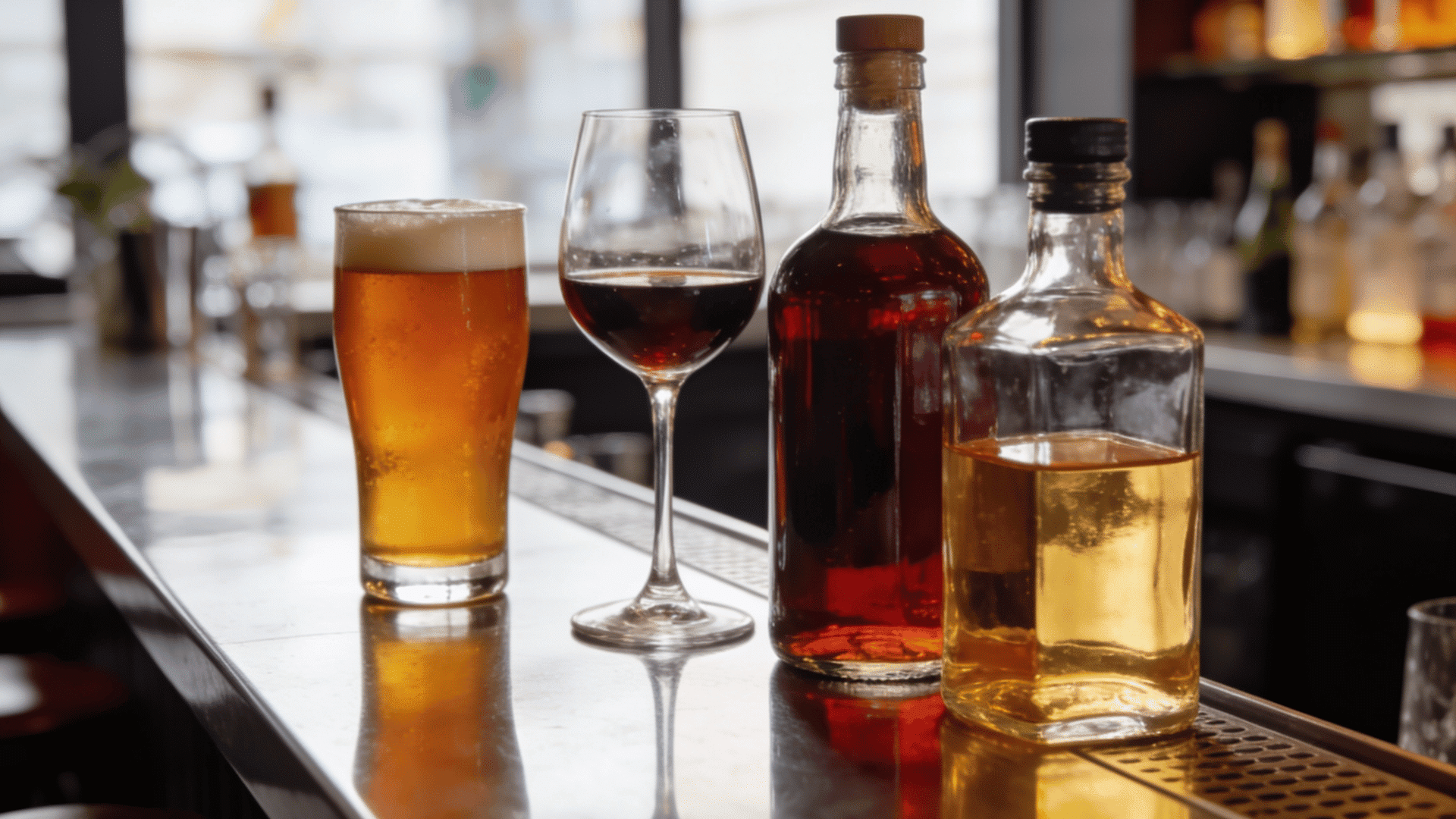
The ABV percentage becomes useful the moment you apply it to an actual serving. Here is how it breaks down across common drink types:
| Drink | Serving Size | ABV | Pure Alcohol |
|---|---|---|---|
| Beer | 355ml (12 oz) | 5% | ~17.75ml |
| Wine | 150ml (5 oz) | 12% | ~18ml |
| Whiskey | 44ml (1.5 oz) | 40% | ~17.6ml |
All three servings contain roughly the same amount of pure alcohol, which is close to the NIAAA’s definition of one standard drink in the United States: approximately 14 grams (0.6 oz).
This is why a shot glass holds so much less liquid than a pint glass but delivers a comparable alcohol hit. ABV is what makes those comparisons possible.
How is Alcohol by Volume Measured?
ABV is not just printed on a label; it is calculated using tested, scientific methods. Here is how alcohol content is measured:
- Hydrometer Test: It measures the liquid’s density before and after fermentation. The difference between the two readings reveals how much sugar was converted to alcohol.
- Ebulliometer: Measures the boiling point of the liquid. Since alcohol boils at a lower temperature than water, the difference in boiling points helps estimate the alcohol content.
- Gas Chromatography: It separates and measures alcohol at a chemical level, making it the go-to for compliance and accurate label verification.
- Refractometer: Uses light refraction to estimate alcohol content by measuring how dissolved sugars bend light.
ABV Across Different Drink Types
ABV varies widely depending on the type of drink and how it is made. Here is a quick reference for typical ranges:
| Drink Type | Typical ABV Range | Examples |
|---|---|---|
| Light beer | 3% – 4% | Bud Light, Miller Lite |
| Regular beer | 4% – 6% | Lagers, ales, IPAs |
| Hard seltzer | 4% – 5% | White Claw, Truly |
| Wine | 11% – 14% | Red, white, rosé |
| Fortified wine | 15% – 22% | Port, sherry, Madeira |
| Spirits | 35% – 50%+ | Whiskey, vodka, rum, gin |
Craft beers are the outliers in the beer category. Strong ales, imperial stouts, and barleywines can exceed 10% ABV, putting them closer to wine territory than a standard lager.
How Brewers and Distillers Control ABV
Brewers and distillers control ABV through several key steps in the production process.
In brewing, ABV is primarily controlled by adjusting the amount of fermentable sugar in the recipe.
More sugar gives yeast more to work with, producing more alcohol during fermentation. Brewers also select specific yeast strains, as different strains stop fermenting at different alcohol levels.
In distilling, ABV is controlled through the distillation process. Heating the fermented liquid separates alcohol from water, since alcohol evaporates at a lower temperature.
Distillers can run multiple distillation cycles to increase strength, then dilute with water to hit a precise ABV before bottling.
High ABV vs Low ABV
Not all drinks hit the same way, and ABV is the main reason why. Here is a side-by-side breakdown of how high and low-ABV drinks differ:
| Factor | High ABV | Low ABV |
|---|---|---|
| ABV range | Typically 15% and above | Usually below 15% |
| Examples | Whiskey, vodka, rum, gin (40%+), fortified wines like port (18–22%) | Beer (4–6%), wine (11–13%), hard seltzers (4–5%) |
| Alcohol strength | Stronger, more alcohol per serving | Milder, less alcohol per serving |
| Taste profile | Bolder, more intense, often warming | Lighter, more refreshing, easier to drink |
| Calorie content | Higher calories per serving | Lower calories per serving |
| Fermentation | Extended fermentation or distillation process | Standard or shorter fermentation |
| Intoxication speed | Faster, with smaller quantities | Slower, requires larger quantities |
| Common use | Sipped slowly, used in cocktails | Casual drinking, social settings |
| Shelf life | Longer, alcohol acts as a preservative | Shorter, especially for low-alcohol beers |
What Happens to ABV During Fermentation?
During fermentation, ABV rises gradually as yeast consumes sugar, converting it into alcohol and carbon dioxide. Here is how it unfolds:
- Yeast Activation: Fermentation begins when yeast is added to the sugar-rich liquid. The yeast starts consuming sugars almost immediately, producing alcohol as a byproduct.
- ABV Rises Steadily: As fermentation continues, alcohol levels climb. The more fermentable sugar available, the higher the potential ABV.
- Yeast Tolerance Limit: Fermentation slows and eventually stops when alcohol levels reach a concentration toxic to the yeast. Tolerance varies significantly by strain: many standard beer yeasts stop between 8% and 12% ABV, while some high-gravity and Belgian strains can handle up to 15%.
- Final ABV Is Set: Once fermentation is complete, the ABV is fixed unless the liquid is diluted, fortified, or distilled further.
ABV vs. Proof: What is the Difference?
Proof is the other alcohol measurement you will see on spirit bottles, and it is simpler than it sounds.
In the United States, proof is double the ABV figure, so an 80-proof whiskey is 40% ABV.
The term dates back to early American and British trade, when spirits were tested by soaking gunpowder and checking if it ignited.
The UK once used a different proof scale but now uses ABV exclusively. Today, proof appears almost entirely on US spirit labels. Wine and beer use ABV only. To convert, divide the proof number by two.
ABV Laws Around the World
ABV limits vary significantly from country to country, shaped by cultural, religious, and public health policies. Here is what the law says across key regions:
1. United States: Beverages above 0.5% ABV are legally classified as alcoholic and regulated by the Alcohol and Tobacco Tax and Trade Bureau (TTB).
2. European Union: Drinks above 1.2% ABV are subject to alcohol labeling laws, which require ABV to be clearly displayed on packaging.
3. Sweden and Norway: Alcohol sales of a certain strength or higher are restricted to government-controlled stores. In Sweden, Systembolaget is the only retailer permitted to sell beverages with an ABV above 3.5%.
4. Saudi Arabia and Kuwait: A complete ban on alcohol is enforced regardless of ABV level, rooted in Islamic law.
5. India: ABV regulation is handled at the state level, meaning rules and permitted strength levels differ across regions.
6. Canada and Australia: Both countries regulate ABV through product classification and taxation tiers, with stronger drinks taxed at higher rates.
Frequently Asked Questions
What is a Standard ABV for Beer?
Most regular beers fall between 4% and 6% ABV. Light beers typically sit around 3% to 4%, while craft and strong ales can go well above 8%.
Does ABV affect how Quickly You Get Drunk?
Yes. A higher ABV means more alcohol enters the bloodstream faster, leading to quicker intoxication. Body weight, food intake, and drinking speed also play a role.
What is the Highest ABV a Beer Can Have?
Most commercial beers stay below 12% ABV. However, extreme craft beers brewed using techniques such as freeze concentration or incremental yeast additions have reached 67.5% ABV (Brewmeister’s Snake Venom, the world’s strongest beer).