


California is home to some of the most recognized wine-growing regions in the United States, from Napa Valley and Sonoma to Paso Robles and Santa Barbara. But the state’s wine country extends far beyond these familiar names.
Each region has different growing conditions, grape varieties, and wine styles.
Some are known for bold Cabernet Sauvignon, while others produce cooler-climate varieties such as Pinot Noir and Chardonnay.
Take a closer look at California’s six major wine regions, their notable appellations, and how AVAs help identify where a wine’s grapes come from.
California Wine Regions
This California wine regions map splits the state into six broad growing areas. Each label covers a large area, not a single town.
The map shows how coastal areas, inland valleys, and mountain foothills divide California’s wine-growing landscape.
The North Coast and Central Coast contain many of the state’s famous appellations. Climate across these areas shapes which wine varieties grow best in each one.
Different wine maps may use four, five, or six broad divisions. The six-area grouping here is the one the Wine Institute uses. It’s a geographic grouping, not an official AVA classification.
Major Wine Regions in California
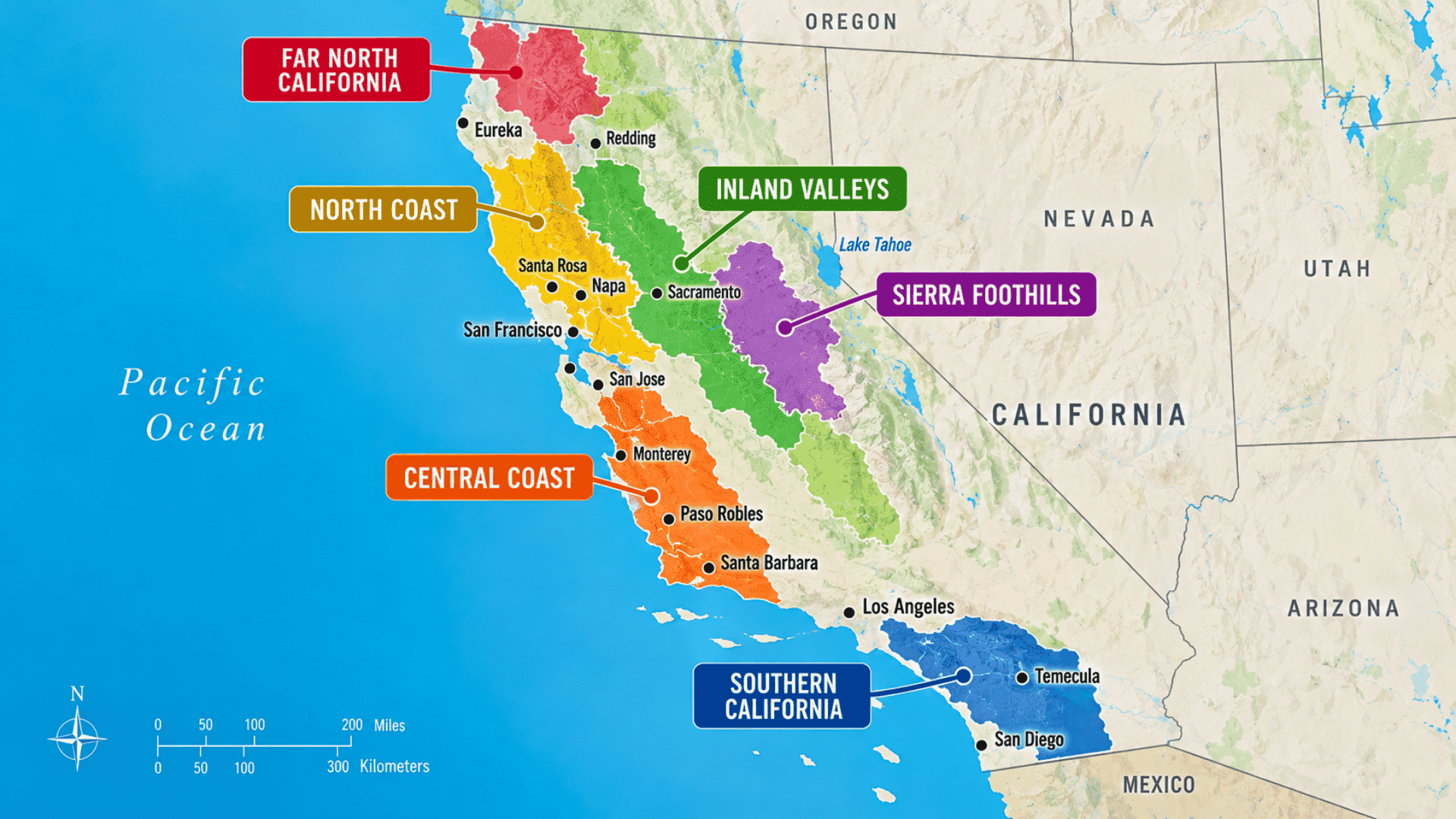
The major wine regions in California are grouped by geography, starting with the two coastal regions most visitors know.
1. North Coast Wine Region
The North Coast lies north of San Francisco and includes Napa, Sonoma, Mendocino, and Lake counties, some of California’s most recognized wine-growing areas.
Napa Valley includes Oakville, Rutherford, and St. Helena, while Sonoma is home to Russian River Valley, Alexander Valley, and Dry Creek Valley.
Mendocino includes Anderson Valley, while Lake County features Red Hills. Napa favors Cabernet Sauvignon, while cooler coastal vineyards produce Pinot Noir and Chardonnay.
2. Far North California Wine Region
Far North California includes smaller wine-growing areas across Shasta, Siskiyou, Trinity, and neighboring counties, with vineyards scattered among valleys and mountain landscapes.
Unlike Napa and Sonoma, this region has fewer large vineyard areas. Its varied elevations and inland conditions create different growing environments.
Recognized appellations include Trinity Lakes in Trinity County, Seiad Valley in Siskiyou County, and Manton Valley, which spans parts of Shasta and Tehama counties.
3. Inland Valleys Wine Region
The Inland Valleys run through California’s Central Valley, between the Coast Ranges and Sierra Nevada, covering the Sacramento and San Joaquin valleys.
Lodi is a major wine-growing area known for old-vine Zinfandel. Its smaller appellations include Mokelumne River, Clements Hills, and Jahant.
Clarksburg, near the Sacramento-San Joaquin River Delta, is known for Chenin Blanc. The Central Valley also produces a large share of California’s wine grapes.
4. Sierra Foothills Wine Region
The Sierra Foothills extend along the western slopes of the Sierra Nevada, east of California’s Central Valley, where vineyards grow across hillsides and valleys.
Important wine-growing counties include Amador, El Dorado, and Calaveras. Amador’s Shenandoah Valley, labeled as the California Shenandoah Valley AVA to set it apart from Virginia’s, is known for old-vine Zinfandel.
The Sierra Foothills AVA covers parts of eight counties. El Dorado and Fair Play are nested appellations, while varying elevations influence vineyard growing conditions.
5. Southern California Wine Region
Southern California’s vineyards extend across Riverside, San Diego, and surrounding counties, with Temecula Valley among the region’s most recognized wine destinations.
Temecula Valley sits in southwestern Riverside County within the larger South Coast AVA. Pacific breezes help moderate temperatures in its inland vineyards.
Other important appellations include Ramona Valley and San Pasqual Valley in San Diego County, along with the historic Cucamonga Valley east of Los Angeles.
6. Central Coast Wine Region
The Central Coast stretches from the San Francisco Bay Area to Santa Barbara County, covering coastal valleys, rolling hills, and several established wine-growing areas.
Major locations include Monterey, Paso Robles, and Santa Barbara. Paso Robles is known for red wines such as Cabernet Sauvignon, Syrah, and Grenache, while Monterey includes Santa Lucia Highlands.
Farther south, Santa Barbara County contains Sta. Rita Hills, Santa Ynez Valley, and Santa Maria Valley, where cooler conditions support Pinot Noir and Chardonnay.
California Wine Regions and Their Major Appellations
Use this table as a quick reference for California wine appellations. It links the six broad regions to key counties and officially named growing areas.
|
Broad Wine Region |
Major Counties or Areas |
Examples of AVAs |
Known For |
|---|---|---|---|
|
North Coast |
Napa, Sonoma, Mendocino, Lake |
Napa Valley, Russian River Valley, Anderson Valley |
Cabernet Sauvignon, Pinot Noir, Chardonnay |
|
Central Coast |
Monterey, San Luis Obispo, Santa Barbara |
Paso Robles, Sta. Rita Hills, Santa Lucia Highlands |
Pinot Noir, Chardonnay, Rhône varieties |
|
Inland Valleys |
Sacramento Valley, San Joaquin Valley |
Lodi, Clarksburg |
Zinfandel, Chenin Blanc, high-volume table wine |
|
Sierra Foothills |
Amador, El Dorado, Calaveras |
Sierra Foothills, El Dorado, Fair Play |
Zinfandel, Barbera |
|
Southern California |
Riverside, San Diego |
Temecula Valley, Ramona Valley, South Coast |
Warm-climate reds such as Syrah |
|
Far North California |
Shasta, Siskiyou, Trinity |
Trinity Lakes, Seiad Valley, Manton Valley |
Small-production estate wines |
Understanding California Wine Appellations (AVAs)
An AVA, or American Viticultural Area, is a grape-growing region with official legal boundaries.
The federal Alcohol and Tobacco Tax and Trade Bureau (TTB) establishes these areas based on geographical features. California has 154 of them, more than any other U.S. state.
Counties follow political boundaries, while AVAs identify areas with shared geographical or growing conditions. Smaller AVAs can sit inside larger ones. Oakville is its own AVA, yet it lies fully within the Napa Valley AVA.
AVAs can also cross county lines. Los Carneros stretches across the southern portions of Napa and Sonoma counties.
On a wine label, an AVA name means at least 85% of the grapes came from that area. Other labeling requirements also apply. An AVA identifies where grapes were grown. It does not guarantee the wine’s quality.
Conclusion
Knowing the major wine regions and their AVAs can help you understand a bottle’s origin and the growing conditions behind it. You may even find a new favorite beyond the state’s better-known wine destinations.
Have you tried wines from California? Which region or variety did you enjoy most? Share your experience in the comments!
Frequently Asked Questions
What is the Oldest Wine Region in California?
Southern California is the oldest. Spanish missionaries planted vines at San Gabriel Mission in 1771, and Los Angeles later grew into an early center of California winemaking.
What is the Largest Wine Region in California?
The Central Valley, covering the Sacramento and San Joaquin valleys, is California’s largest wine-producing area by volume. Its extensive vineyards supply grapes for many of the state’s commercial table wines.
What is the Wine Capital of California?
Napa is often called California’s wine capital because of its international reputation, especially for Cabernet Sauvignon. However, California has no officially designated wine capital, so the title is informal.