
If you have ever picked up a bottle of whiskey or vodka and spotted a number like “80 proof” on the label, you are not alone in wondering what that actually means.
Most people know it has something to do with how strong the drink is, but the exact meaning stays fuzzy.
Whiskey, vodka, rum, and gin all belong to the broader category of distilled spirits, which are typically stronger than beer or wine.
By the end, you will be able to read any spirits label with full confidence. Ready to stop guessing at the liquor store? Keep reading.
What Does Proof Mean in Alcohol?
Alcohol proof is a number printed on a bottle that tells you how strong the spirit is. In the United States, proof is always exactly twice the alcohol-by-volume percentage.
So if a bottle says 80 proof, that means it contains 40% alcohol by volume. The term is used almost exclusively for distilled spirits such as whiskey, vodka, rum, and gin.
You will not typically see proof listed on beer or wine labels, since those products use ABV as their standard measurement.
Think of proof as a shorthand the American spirits industry settled on long ago. Once you know the simple relationship between proof and ABV, reading any label becomes quick and easy.
Quick Proof and ABV Reference Chart
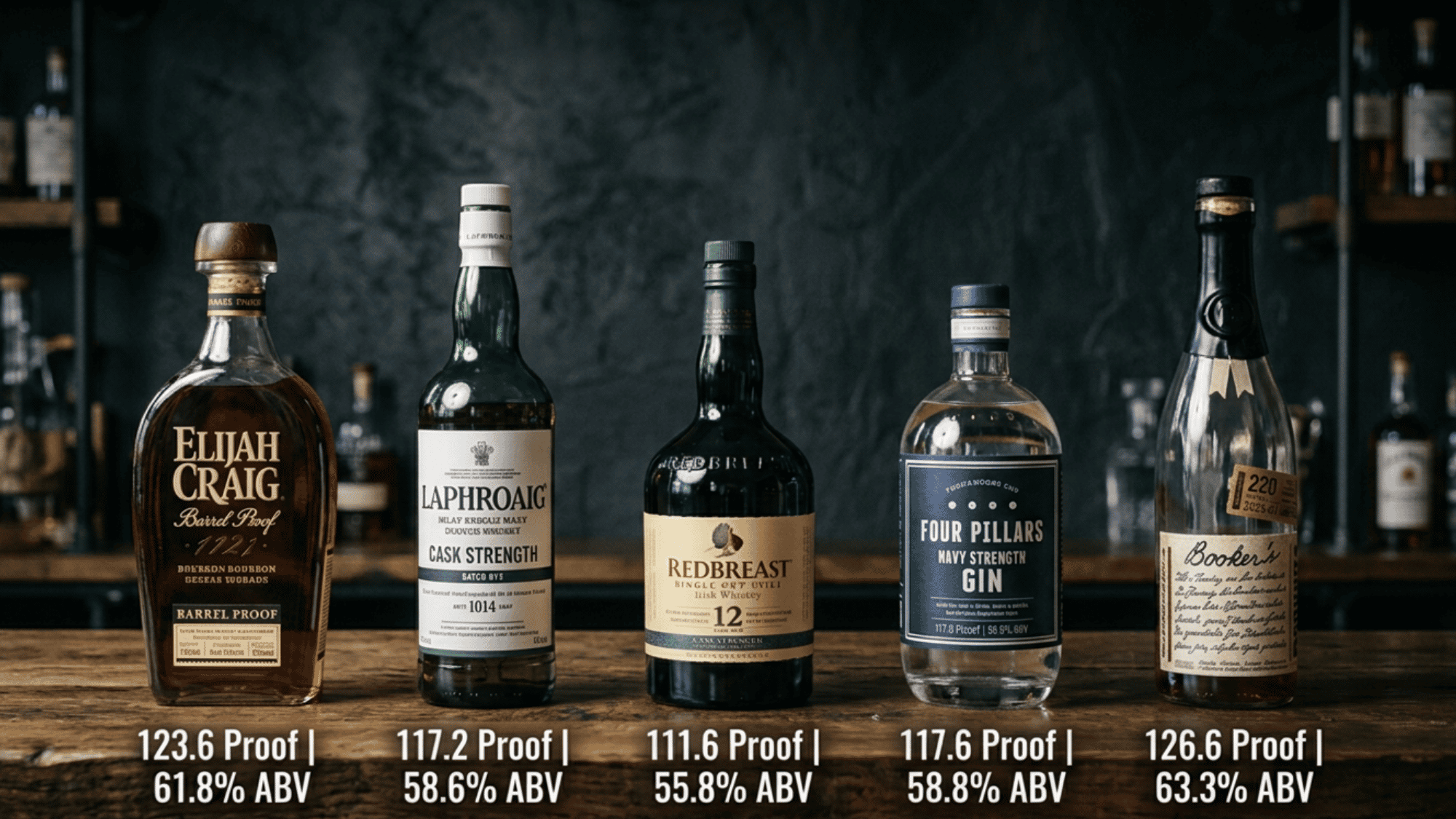
The chart below gives you a fast reference for the most common proof levels you will see on spirits labels in the United States.
Each row shows the proof, the matching ABV percentage, and a real-world example of the type of spirit that typically falls at that strength.
Use this as a quick lookup whenever you are at a store or reading a recipe that calls for a spirit at a specific strength.
Anything above 100 proof is considered high-strength, and anything below 80 proof leans toward the lighter side for a distilled spirit.
| Proof | ABV | Common Example |
|---|---|---|
| 40 Proof | 20% ABV | Lower-alcohol liqueurs |
| 80 Proof | 40% ABV | Standard vodka, most whiskeys |
| 100 Proof | 50% ABV | Bottled-in-bond bourbons |
| 120 Proof | 60% ABV | Cask-strength spirits |
What is the Percentage of Alcohol?
Alcohol percentage refers to ABV, which stands for alcohol by volume. It is the standard way the world measures how much pure alcohol is in any drink.
The number tells you what portion of the total liquid is actually alcohol. A bottle marked 5% ABV is mostly water and other ingredients, with only a small share being alcohol.
A bottle at 45% ABV has nearly half its volume as pure alcohol. Beer typically falls between 4% and 7% ABV, wine usually sits between 11% and 14%, and spirits range from around 20% on the low end to 60% or more for high-strength options.
ABV is printed on every type of alcoholic drink sold commercially, making it the most reliable number to check when you want to know exactly how strong something is.
Proof vs Percentage in Alcohol
ABV stands for “alcohol by volume.” It tells you the exact percentage of pure alcohol in a bottle.
A bottle with 40% ABV means 40 out of every 100 milliliters is alcohol, and the remaining 60 milliliters is water and other compounds. Proof is simply the ABV number multiplied by two.
The two measurements describe the same thing, just on different scales. Whiskey alcohol content can vary considerably, depending on the style, aging process, and bottling proof.
If a label shows only proof, you can always work out the ABV instantly by halving it. If it shows only ABV, doubling it gives you the proof.
Here is a quick side-by-side comparison:
| Measurement | What It Tells You | Example |
|---|---|---|
| ABV (%) | Actual alcohol content by volume | 40% ABV |
| Proof (US) | ABV × 2 | 80 Proof |
Common Misunderstandings About Alcohol Proof
Many beginners misread alcohol labels, which can lead to choosing the wrong bottle or making a drink much stronger than intended. Here are the most common mistakes to avoid.
An 80-proof spirit is 40% alcohol, not 80%. In the United States, proof is always double the alcohol-by-volume (ABV) percentage.
Higher proof does not automatically mean a harsher taste. Distillation quality, ingredients, and aging can have just as much impact on flavor as alcohol strength.
Switching to a higher-proof spirit can significantly change a cocktail. Replacing an 80-proof spirit with a 100-proof version without adjusting the recipe can increase the drink’s strength and alter its balance.
Does Proof Affect How You Drink It?
Proof affects more than just strength. It changes how a spirit feels on your palate, how well it holds up in a cocktail, and how it behaves in the kitchen. Picking the right proof for the right situation genuinely matters.
- Sipping Straight: 80 proof is easier to drink neat. The warmth is mild and approachable. At 100 proof and above, the heat and intensity on the finish become much more noticeable.
- Mixing Cocktails: Higher-proof spirits hold their flavor against strong mixers. An 80-proof spirit can get lost in citrus or soda, while 90- to 100-proof spirits stay present throughout the drink.
- Cooking with Alcohol: Higher-proof spirits ignite faster for flambeing and release flavor more quickly in sauces. For most everyday cooking, 80 proof does the job just fine.
Proof and ABV are closely related, but understanding what ABV stands for makes alcohol labels much easier to read.
The Bottom Line
Proof and ABV measure the same thing, just on different scales. In the United States, proof is always double the ABV, so 80 proof means 40% alcohol and 100 proof means 50% alcohol.
ABV is the cleaner number for comparing any two drinks side by side, but proof is still printed on most American spirits labels, so knowing both saves you time and guesswork every time you shop.
Once you understand the simple relationship between the two, reading any bottle label takes only a few seconds. Found this helpful? Share it with someone who always wondered what proof actually means.
Frequently Asked Questions
Can You Make Alcohol Less Strong by Adding Water?
Yes. Adding water lowers the proof and ABV. Distilleries do this intentionally before bottling to bring cask-strength spirits down to a standard strength.
Does Freezing Alcohol Change Its Proof?
No. Freezing only changes the temperature, not the alcohol content. That is why high-proof spirits stay liquid in a standard home freezer.
Why Do Some Bottles Say “Barrel Proof” Instead of A Number?
Barrel proof means no water was added before bottling. The proof varies batch to batch, so a fixed number is not always printed on the label.
Does a Higher Proof Spirit Get You Drunk Faster?
It can. Higher proof means more alcohol per sip, so the same pour carries more alcohol than an equivalent amount of a lower-proof spirit.